Transforaminal Decompression
Disc herniation and spinal stenosis are common health problems worldwide. Endoscopic spinal surgery has been proven to be a good alternative to conventional surgical methods for a variety of spinal conditions.
Transforaminal Endoscopic Access
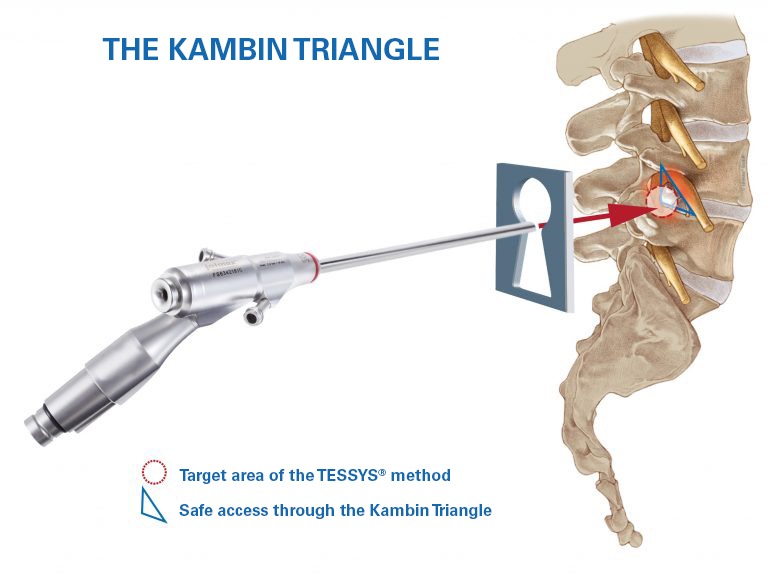
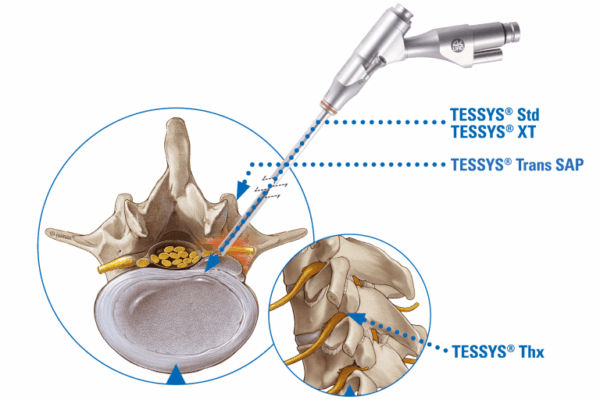
The TESSYS®method – with access through the intervertebral foramen – is a widely used spinal endoscopy technique and has been shown to be an exceptionally patient-friendly procedure with few complications1. The access route passes through the Kambin’s triangle which is bordered by the exiting nerve root, endplate of the lower vertebra, and traversing nerve root.
The triangle is free of supporting structures and nerve tissue, providing a safe zone for endoscopic access to pathologies within the spinal canal. Herniations, sequestered disc tissue and hypertrophic tissue can be removed under direct visualization by the instruments passing through the endoscope working channel. Almost all types of disc herniations can be treated with TESSYS®2.
Selected Indications
Radicular symptoms caused by herniated discs that have not improved with conservative treatment are indications for surgery with the TESSYS® surgical approach. Cauda equina syndrome requires immediate surgical treatment. Every surgical procedure on a spinal disc must be planned carefully using Magnetic Resonance Imaging (MRI) and/or Computed Tomography (CT), and conventional X-ray images.
Indication Overview
- Herniated discs
- Spinal stenosis
- Degenerative disease of ligamentum flavum
- Cauda equina syndrome
- Dorsal facet joint cysts
Advantages of Endoscopy
- Smaller incision
- Less trauma/ less scarring/ better cosmesis
- Reduced blood loss
- Reduced duration of the surgical operation
- Less pain
Disclaimers
Certain products may not be approved for sale in all countries.
1. Gibson, J. N. Alastair, Jonathan G. Cowie and Menno Iprenburg. “Transforaminal Endoscopic Spinal Surgery: The Future ‘gold Standard’ for Discectomy? – A Review.” The Surgeon: Journal of the Royal Colleges of Surgeons of Edinburgh and Ireland 10, no. 5 (October 2012): 290-96. https://doi.org/10.1016/j.surge.2012.05.001.
2. Wagner, Ralf and Monika Haefner. “Indications and Contraindications of Full-Endoscopic Interlaminar Lumbar Decompression.” World Neurosurgery 145 (January 2021): 657-62. https://doi.org/10.1016/j.wneu.2020.08.042.